Monday, January 4, 2016
New Years Goals
My first goal for the new year is I need to start putting more time aside to study. I need to be more on track with when my tests and quizzes are and plan ahead to make sure that I have enough time to go over everything and have time to study well. I also need to study more thoroughly for all of my classes. My second goal is I need to get more sleep. For me to get more sleep I need to go to bed earlier, which means I have to get my homework done earlier so I am not up late trying to finish it. I usually procrastinate when I get home from school, but I want to start getting my homework done quicker so I have more time so I can go to bed earlier. It will also help me be more awake during school.

Thursday, November 12, 2015
Sheep Heart Dissection Reflection Questions
1. What is the purpose of the pericardium?
The pericardium is a sac of serous membranes that secretes a fluid to lubricate the heart and reduce friction. It is made of visceral and parietal layers.
2. How do arteries differ from veins in their structure?
Veins carry blood from the tissues to the heart and arteries carry blood away from the heart to the tissues. Veins have thinner walls, arteries are larger and are under higher pressure.
3. What function does the auricles serve?
They are chambers that blood enters the heart.
4. What external differences of the atria and ventricles do you observe?
The walls of the ventricles are thicker, the atrium's are above the ventricles and they are smaller than the ventricles.
5. Find the following structures, and use pictures or words to describe each.
a. Coronary Sinus: receives blood from the coronary veins, and flows into the right atrium.
b. Inferior Vena Cava: Large vein that carries deoxygenated blood into the heart. Carries blood from the lower body.
c. Right Atrioventricular Valve (Tricuspid Valve): It allows blood to flow in one direction and it prevents back flow of blood. The Tricuspid Valve is between the right atrium and the right ventricle.
6. Draw a picture of the Tricuspid Valve including the chordate tendinae and the papillary muscle.

7. Why is the "anchoring" of the heart valves by the chordate tendineae and the papillary muscle important to heart function? They are there to prevent the tricuspid and bicuspid valves from collapsing into the atrium when it contracts.
8. Using pictures and/or words, describe what you see (bicuspid valve): It prevents back flow of blood, and allows blood to flow in one direction, it is between the left atrium and the left ventricle, and is also called the mitral valve.
9. What is the function of the semi-lunar valves? Semi-lunar valves prevents arterial blood from re-entering the heart.
10. a. If the valve disease occurs on the right side of the heart, it results in swelling in feet and ankles, why might this happen? Because the right side of the heart deals with deoxygenated blood, so the feet and ankles are not getting oxygenated blood.
b. If valve disease occurs on the left side of the heart, what complications would you expect to see?
The left side of the heart deals with oxygenated blood, so deoxygenated blood would be filling up the lungs, so the lungs would swell.
11. Using pictures or words, describe what you see: The coronary tendineae connects the papillary muscle to the bicuspid valve.
12. Describe the left and right sides of the heart differ from each other?
The right side of the heart deals with deoxygenated blood and the left side of the heart deals with oxygenated blood. The right side of the heart goes to the lungs and the left side comes from the lungs.
13. Draw and label all structures visible in the interior of the cross section.
The pericardium is a sac of serous membranes that secretes a fluid to lubricate the heart and reduce friction. It is made of visceral and parietal layers.
2. How do arteries differ from veins in their structure?
Veins carry blood from the tissues to the heart and arteries carry blood away from the heart to the tissues. Veins have thinner walls, arteries are larger and are under higher pressure.
3. What function does the auricles serve?
They are chambers that blood enters the heart.
4. What external differences of the atria and ventricles do you observe?
The walls of the ventricles are thicker, the atrium's are above the ventricles and they are smaller than the ventricles.
5. Find the following structures, and use pictures or words to describe each.
a. Coronary Sinus: receives blood from the coronary veins, and flows into the right atrium.
b. Inferior Vena Cava: Large vein that carries deoxygenated blood into the heart. Carries blood from the lower body.
c. Right Atrioventricular Valve (Tricuspid Valve): It allows blood to flow in one direction and it prevents back flow of blood. The Tricuspid Valve is between the right atrium and the right ventricle.
6. Draw a picture of the Tricuspid Valve including the chordate tendinae and the papillary muscle.

7. Why is the "anchoring" of the heart valves by the chordate tendineae and the papillary muscle important to heart function? They are there to prevent the tricuspid and bicuspid valves from collapsing into the atrium when it contracts.
8. Using pictures and/or words, describe what you see (bicuspid valve): It prevents back flow of blood, and allows blood to flow in one direction, it is between the left atrium and the left ventricle, and is also called the mitral valve.
9. What is the function of the semi-lunar valves? Semi-lunar valves prevents arterial blood from re-entering the heart.
10. a. If the valve disease occurs on the right side of the heart, it results in swelling in feet and ankles, why might this happen? Because the right side of the heart deals with deoxygenated blood, so the feet and ankles are not getting oxygenated blood.
b. If valve disease occurs on the left side of the heart, what complications would you expect to see?
The left side of the heart deals with oxygenated blood, so deoxygenated blood would be filling up the lungs, so the lungs would swell.
11. Using pictures or words, describe what you see: The coronary tendineae connects the papillary muscle to the bicuspid valve.
12. Describe the left and right sides of the heart differ from each other?
The right side of the heart deals with deoxygenated blood and the left side of the heart deals with oxygenated blood. The right side of the heart goes to the lungs and the left side comes from the lungs.
13. Draw and label all structures visible in the interior of the cross section.

Wednesday, November 11, 2015
Unit 3 Reflection
This unit taught us all about the circulatory system, the major components, specific parts, accessory organs, and much more. The cardiovascular system is a fluid filled network of tubes or vessels, through which materials move between the environment and the cells of a multicellular animal. Cardiovascular health is making sure that you keep your heart healthy. Theres several things that cause heart attacks, a heart attack is when blood supply to the myocardium is severely reduced, or stopped resulting in damage to the heart cells or death of heart cells. This is caused by one or more coronary arteries blocked, usually due to atherosclerosis. Stroke is a brain injury that occurs when blood supply to part of the brain is interrupted. This is also often caused by atherosclerosis, but can be caused by an aneurysm. To promote your cardiovascular health, you can control your blood pressure, stop smoking, control cholesterol, eat a healthy diet, drink alcohol in moderation, control diabetes, control your weight, exercise, manage your stress, and your genetic history. I think this unit was very interesting because it applies to our lives, and it helped me understand what happens when these things go wrong. Also it taught me ways of identifying these situations, which is important to know. This unit we did our first dissection, and it was helpful to actually see the parts of the heart it made it easier to understand how it works. For the remainder of the semester, I want to study more and the temp checks are very helpful, so its nice when we have them because it lets me know how much information I retained, so my goal is to study more and do better on tests.
 |
| Sheep heart dissection |
 |
| Heart Diagram |
 |
| Atherosclerosis |
Monday, October 26, 2015
Monday Wellness: Snacking
The snack we made during class was healthy because we used apples which are a good source of vitamin c,and organic peanut butter which has no trans fats, and it almonds which the peanut butter and almonds has a lot of iron and magnesium. I usually eat snacks every couple of hours, depending on when i'm hungry. A healthy snack is something that isn't artificially flavored. Snacks to stay away from would probably things with a lot of empty calories and with little nutritional values.


Tuesday, October 13, 2015
Blood Pressure Lab
Systolic Blood pressure is the first number you record when taking someones blood pressure. For example if your blood pressure is 120/80 the systolic blood pressure is 120. It represents the pressure when the heart contracts. Your diastolic blood pressure is the second number and it is when the heart relaxes. We used a stethoscope to measure our heart rates, and to measure our blood pressure we used stethoscope and a sphygomomanometer. Using your thumb to measure blood pressure is not ideal because your thumb has a heart beat also, so it would interfere with the other heart beat your measuring. To use a sphygomomanometer you put it on the person's upper arm whose blood pressure is being measured and you tighten it so its tight but not restricting. To record the blood pressure you need a stethoscope so you would place it on their inner elbow and the hearing parts in your ears to listen, then you would have one hand on the stethoscope and your other hand holding the bulb that you squeeze your hand and it pumps air into the arm cuff. You pump the bulb until its around 180 and then you slowly release the air, you listen for the heart beat and as soon as you hear it you record the first number and then when the heart beat noise stops you record that number too. You put the first number you recorded over the second number you recorded and thats your blood pressure.
 |
| Charts |
 |
| Blood Pressure Cuff and Stethoscope |
Sunday, October 11, 2015
Unit 2 Reflection
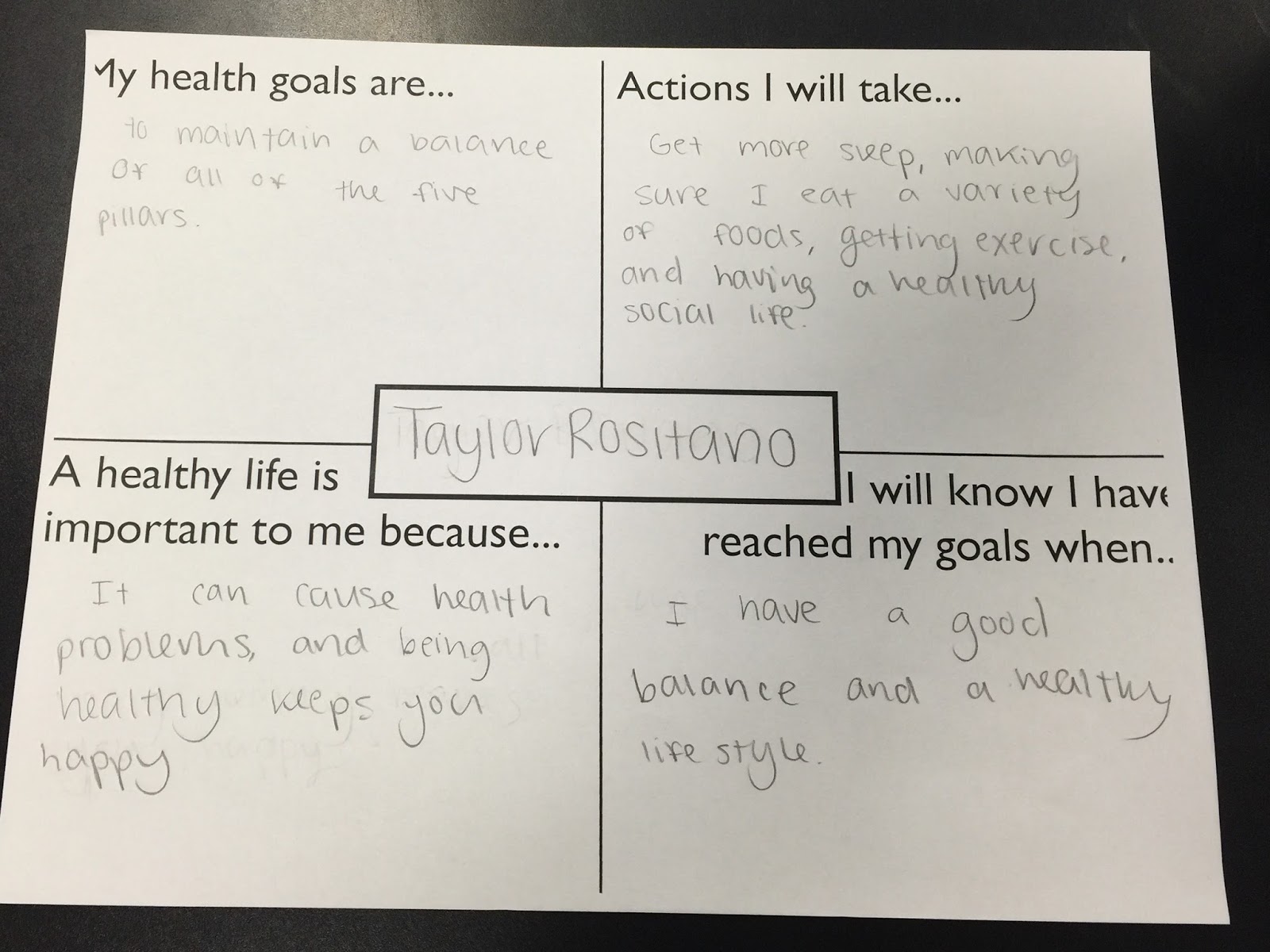
Health is the measure of our bodies efficiency and over all well being. Being healthy means you have a good balance of all of the five pillars of health, nutrition, exercise, sleep, stress, and social. We learned that nutrition is really important because the nutrients support growth and energy needs, also its important to exercise often because it keeps you healthy and helps strengthen your body. Sleep is extremely important because it gives your body time to rest and restore, stress deals with managing constant changes to your body and mind, so its important to manage stress well. Your social life is the way we interact with our environment, so when you have a poor social life it can cause stress, keeping a good social life will help keep you healthy. For my personal health, I would say I'm an averagely healthy person. For nutrition, there were certain things I should change, like eating more seafood, and less salty foods. My social life is good, I have a really good group of friends that keep me happy. I play sports everyday for the correct amount of time, and for sleep I get a but under what I should be. I get very little sleep during the week, and then on weekends I sleep for a very long time, so I need to find a balance so that I can get into having a normal sleep schedule. That would help me be more motivated and it would help me focus during school.
This unit taught me a lot of things that can be applied to my life, which was very helpful. I learned more about the foods we should be eating and why we need them. For example, we need proteins for energy (if needed), repair and maintenance, hormones, and the transportation and storage of molecules. Also I learned why its so important to stay hydrated, because all of our cell and organ functions depend on it, and it helps regulate our body temperature. For exercise, Mr.Orre told us what types of exercise there are, what intensities you should be doing, the three metabolic pathways, and how much exercise we should be getting in order to stay healthy. You should be getting 150-300 minutes of moderate to high intensity exercise. We learned about sleep and the hormones that effect our sleep, like cortisol and melatonin. Cortisol is a hormone that is secreted by the adrenal glands and it tells your brain that its daytime and it wakes you up. Melatonin is a hormone secreted by the pineal gland, it causes you to feel sleepy. Most teenagers need around 9-10 hours of sleep a night and when you don't get enough sleep, your sleep debt keeps adding up. Mr.Orre also told us about stress, when its good and when its bad.
Something I didn't fully understand was the hormones lesson, about insulin, leptin, leptin resistance, glucagon and cortisol. To improve for the next unit I will make sure I get enough sleep so that in class I am awake and alert, also I will make sure I take good notes, and study better for the unit test. I can connect this unit to my life because I play sports everyday, so it helped me understand why it is important, also all of the topics we learned about helped me learn how to improve my health. For example I play waterloo, which is good exercise, plus it also effects my social life, we have a very close team, and we have a stronger team because we get along so well together.
This unit taught me a lot of things that can be applied to my life, which was very helpful. I learned more about the foods we should be eating and why we need them. For example, we need proteins for energy (if needed), repair and maintenance, hormones, and the transportation and storage of molecules. Also I learned why its so important to stay hydrated, because all of our cell and organ functions depend on it, and it helps regulate our body temperature. For exercise, Mr.Orre told us what types of exercise there are, what intensities you should be doing, the three metabolic pathways, and how much exercise we should be getting in order to stay healthy. You should be getting 150-300 minutes of moderate to high intensity exercise. We learned about sleep and the hormones that effect our sleep, like cortisol and melatonin. Cortisol is a hormone that is secreted by the adrenal glands and it tells your brain that its daytime and it wakes you up. Melatonin is a hormone secreted by the pineal gland, it causes you to feel sleepy. Most teenagers need around 9-10 hours of sleep a night and when you don't get enough sleep, your sleep debt keeps adding up. Mr.Orre also told us about stress, when its good and when its bad.
Something I didn't fully understand was the hormones lesson, about insulin, leptin, leptin resistance, glucagon and cortisol. To improve for the next unit I will make sure I get enough sleep so that in class I am awake and alert, also I will make sure I take good notes, and study better for the unit test. I can connect this unit to my life because I play sports everyday, so it helped me understand why it is important, also all of the topics we learned about helped me learn how to improve my health. For example I play waterloo, which is good exercise, plus it also effects my social life, we have a very close team, and we have a stronger team because we get along so well together.
 |
| Nutrition |
 |
| Goals Sheet |
 |
| Exercise/Social |
Thursday, October 1, 2015
Monday Wellness Reflection: Warm ups and Cool downs
My partner and I chose this topic because we felt that it was a topic that almost everyone could benefit from. Many students engage in sports or take part in some kind of exercise, so it could help improve a lot of students lives. Me and my partner play waterloo, so we thought it was important for us to know the importance of warming up before activity, and cooling down after. We wanted to make sure we knew also a proper warm up and cool down that was effective. Theres a lot of interesting information about warm ups and cool downs, but we learned that when you warm up theres a lot of things that take place in your body, like increasing body temperature, blood circulation, and it helps your coordination and reaction times improve that all help your body prepare to workout. We also found it interesting that when you warm up its supposed to dilate your blood vessels. Something really important about your warmups and cool downs is that its extremely important to keep hydrated before, during, and after vigorous activity. Being dehydrated can cause you to become very lightheaded and dizzy, when our water polo team is practicing we always have big water jugs, and our coach is always constantly reminding us to drink more water. This topic is really important to your health, because if you don't warm up its very easy to get an injury, plus your body has to work a lot harder for you to workout which can cause cramps. Warming up prepares your body for exercise, so when you don't warm up theres a lot of things that can go wrong. Ive noticed when I don't get a good warm up or when I'm not fully warmed up yet and we start to play, its harder for me to catch and throw because my arm muscles don't feel stretched out and its a bit painful. Also when you don't warm up its harder for us to swim faster, which I've noticed during practice. Its very important to cool down because if you stop working right after a workout and don't cool down, it can make you feel light headed and dizzy, also its possible for you to faint. Cool downs help make sure your heart rate and blood pressure drop at a normal rate, because if not it could drop rapidly. Also when you stretch after a workout it reduces the buildup of lactic acid, which can cause muscle cramps and stiffness. On a scale of one to ten I would give us a 8 because I think we covered everything very well and had a good activity, however we did fall short on time. Even though we came short with time, I think we covered a good amount of information, and that the students benefited from our presentation. I really liked doing this project, I think me and Sophie worked well together and our activity was fun and really interactive, when I got back to my seat, someone sitting at my desk told me that it helped wake her up. Theres always room for improvement, but i think we did a good job overall. https://docs.google.com/presentation/d/174YfI86ll-wqBeWOV-odRIM0vDHIaYrYbmOegVihlg8/edit#slide=id.gbceffb9ad_1_25
Subscribe to:
Posts (Atom)