Wednesday, May 11, 2016
20 time reflection
For my 20 time project, Sophie and I came up with our idea because of our shared interest in hiking. We decided we wanted to make a blog where we could share information about hiking trails. We wanted to give people a place to go to find new trails and get information about them like intensity, how to get there, distance and other important things. We created the blog and started posting reflections on trails weekly. We also had a goal to monitor the amount of trash on the trails we chose so that at the end we could organize a group of our friends and students to go clean up a trail. We planned on doing the clean up on may 6th, but because of weather we had to reschedule it to later this week. We challenged ourselves because we had to set a lot of time aside so that we could go on all these different trails. We learned a lot, we didn't know how many different trails there were in this area but we got to visit and see a lot. We found a lot of different animals and interesting things. We did research and learned about all of the health benefits of hiking. If I were to do this project again but differently maybe I would chose some more difficult trails or travel further to see some of the more popular trails.

Tuesday, May 10, 2016
Reflexes Lab
In this lab we tested our reflexes by doing a series of tests. For the first test to test our photopupillalry reflex, we covered one of our eyes and shined a flashlight over the hand, so when we removed the hand we watched the pupil to see it change in size. The autonomic reflex is responsible for regulating the changes in pupil size. We learned that when the intensity of light entering the eye increases, the photopupillary reflex is triggered and it stimulates the cilliary body to contract. Next, we hit our knee to see if it would kick out to test our monosynaptic reflex. When you hit below the knee, it causes the thigh muscle to stretch. The knee jerk reflex has two neuron reflex arcs, it goes from sensory neuron to spinal cord to motor neuron to the knee. For the next reflex, we tested the blink reflex by having someone stand with a piece of saran wrap in front of their face and have another person throw a cotton ball at it and observe if the person blinks. The blink reflex is important because it protects the eye from things that could damage it. To test our plantar reflex, we dragged a pen up the sole of the foot from heel to the base of the big toe, and observed if the toes moved closer together or further apart, and for us they moved closer together which is normal. The toes might move further away if there is nerve damage, this could be a sign that the nervous system isn't completely myelinated. By dropping a ruler, having someone catch it and recording the number of inches the ruler dropped we could calculate the amount of time it took for us to activate our visual and motor reflexes. We did the trial 3 times and took an average, then tried it again but while the ruler was being dropped you had to write a text with one hand and catch the ruler with the other hand. By adding in that we had to type out a text, it slowed down our reaction time and made it harder for us to respond and catch the ruler.
 |
| Eye when first exposed to the light |
 |
| eye after exposed to light pupil got smaller |
Wednesday, May 4, 2016
Brain Map
The frontal lobes control your personality, helps with problem solving, memory, language and judgement. The frontal lobes also controls your critical thinking and problem solving skills. The last part of your brain to develop is the frontal lobes and to prevent it from deteriorating you can do exercises, but it still deteriorates with age. The neo cortex helps navigate your body, it controls your awareness, senses, and motor skills. The pre frontal cortex controls your personality also, and how you behave in social settings. There is a part of the pre frontal cortex that tries to prevent you from doing two things at the same time. The broca's area is responsible for speech production and language comprehension, tongue twisters may help improve part of your brain. The sensory cortex is the part of your brain that is responsible for interpreting information from your senses. Your visual cortex helps you differentiate colors and recognize faces. Parts of your occipital lobe sense motion and process visual information. The occipital lobe helps you process short and long term memories. If your temporal lobes were damaged, you would have trouble remembering things because this is where your brain stores memories. Your fast brain picks up information in milliseconds. A neurotransmitter that is important to me is glycine, because it is used by neurons in the spinal cord which is really important. The corpus callosum connects the two hemispheres of the brain. Listening to music can strengthen your corpus callosum. The thalamus has nerve networks that send signals to the brain.
Relate and Review:
In this brain map stimulation, I got to see the different parts of the brain and their functions. I also got to read more interesting facts about the different parts and figure out what would happen if these different parts were damaged. In the stimulation I got to read about the frontal lobes, neo cortex, occipital lobe, frontal cortex, the sensory cortex, and much more. It helped me more understand how people are different, like how the pre frontal cortex controls your personality and how you behave in social settings showed me how some one with a different pre frontal cortex could be completely different. Also how the man who damaged his frontal lobes how his friends said he was a totally different person after the injury shows how important your brain is.
Relate and Review:
In this brain map stimulation, I got to see the different parts of the brain and their functions. I also got to read more interesting facts about the different parts and figure out what would happen if these different parts were damaged. In the stimulation I got to read about the frontal lobes, neo cortex, occipital lobe, frontal cortex, the sensory cortex, and much more. It helped me more understand how people are different, like how the pre frontal cortex controls your personality and how you behave in social settings showed me how some one with a different pre frontal cortex could be completely different. Also how the man who damaged his frontal lobes how his friends said he was a totally different person after the injury shows how important your brain is.
Monday, May 2, 2016
Sheep Brain Dissection
 |
| This shows the anterior side of the brain (white), posterior side(black), the cerebellum(green), the cerebrum(yellow), and the brain stem(red). |
 |
| Sketch of the brain cut in half |
 |
| sketch of the brain untouched |


 |
| white and grey matter |
Wednesday, April 27, 2016
Sheep Eye Dissection
 |
| This is the eye when we first got it, it is covered in a lot of fatty tissue |
 |
| The yellow ball shaped thing in the picture is the lens, and it is surrounded in the vitreous humor. |
 |
| we cut the cornea off, and you can see the pupil opening, on the side you can see the bright colored tissue on the side or the tapetum lucidum. |
Thursday, April 14, 2016
"The Woman with a hole in her brain"
In this article it talks about a woman who was unaware of the fact that she is missing her cerebellum until she was 24. She went to the hospital because she was nauseous and dizzy and they did a CAT scan and it showed that where her cerebellum should be it was filled with cerebrospinal fluid. She had trouble walking most of her life and she also wasn't able to speak that well until she was 7. The cerebellum is 10% of the brains volume but 50% of the brains neurons. The cerebellum's function is it controls your voluntary movements and balance.
The Parietal Lobe
The parietal lobe controls sensations, it deals with and reacts to environment and it processes sensory information. If your parietal lobe is damaged, the person will have trouble reading, recognizing things and people. It will be harder for them to be aware of their bodies. People with damaged parietal lobes have trouble multitasking, issues with telling right and left apart and the mathematic skills they have is often reduced. You can't live without the parietal lobe.
The Parietal Lobe
The parietal lobe controls sensations, it deals with and reacts to environment and it processes sensory information. If your parietal lobe is damaged, the person will have trouble reading, recognizing things and people. It will be harder for them to be aware of their bodies. People with damaged parietal lobes have trouble multitasking, issues with telling right and left apart and the mathematic skills they have is often reduced. You can't live without the parietal lobe.
The Clay Brain
We studied the brain and made a model of the left hemisphere along the sagittal plane and the right cerebral hemisphere using clay on cardboard. We traced an outline of the brain with pencil and filled in the spots with different colored clay, then labeled the parts in a key.


Thursday, March 24, 2016
Unit 7 Reflection
 In this unit, we learned about the muscular system. There are a lot of different joints and defining characteristics for them. For example, there are levers, which is a rigid object that rotates around a fixed point called a fulcrum. Rotation occurs when effort overcomes resistance. There are first class levers, second class levers and third class levers. Joints are the point of a connection between two bones or elements of a skeleton especially if it allows motion. Ligaments are bone to bone, and tendons are bone to muscle. The functional classification of joints are synarthroses, or immovable joints, amphiarthroses, or slightly movable joints, and diarthroses, or freely movable joints. There are fibrous joints which are generally immovable, cartilaginous joints, which are immovable or slightly movable, and synovial joints which are freely movable. There are 17 different directional terms and joint movements that we learned about. For example, flexion is the movement that decreases the angle between two bones and extension is the movement that increases the angle between two bones. Muscles are very important in our bodies because they do a lot of things, like the movement of bones, maintaining posture and body position, stabilizing joints, and heat generation. There are a few properties of muscle tissue, excitability, or the ability to receive and respond to stimuli, contractility, or the ability to shorten when stimulated, extensibility, or the ability to be stretched, and elasticity, or the ability to recoil to resting length. Connective tissues components are fascia (thin sheets of fibrous connective tissue that holds muscle fibers together), epimysium (fascia that surrounds the entire muscle), perimysium (separates muscles into bundles), endomysium (fascia that surrounds each muscle fiber), and tendon (a cord of dense regular connective tissue composed of collagen that attaches muscle to periosteum to bone). Origin is the immovable end of the muscle and insertion is the movable end of the muscle, when a muscle contracts the insertion is moved towards the origin. We learned about skeletal muscle, and that its composed of thousands of bundles of muscle fibers. We did a chicken dissection, where we located all of the main muscles and labeled them. We wrote reflections on our blogs. My Chicken Dissection Reflection. Mr. Orre taught us about the three different types of muscle fibers. There slow twitch fibers which are slow oxidative, fast twitch fibers which are fast oxidative, and fast twitch fibers which are fast glycolytic. The general effects of exercise on muscles is it helps to increase metabolism, strengthens bones, increases muscular endurance, helps prevent injuries, and it increases coordination and balance. Hypertrophy is when cells increase in volume due to move myofibrils, and hyperplasia is when cells remain the same in size, but they increase in number. We made a stop motion video to show how muscle contractions work. Our Muscle Contraction Video To keep our muscles healthy it is important to exercise regularly, eat healthy, don't smoke, know basic first aid, and you should train aerobically and anaerobically. We also were taught about performance enhancement substances and how it effects our bodies. This unit, we learned a lot about the muscular system, and it helped me understand it a lot more.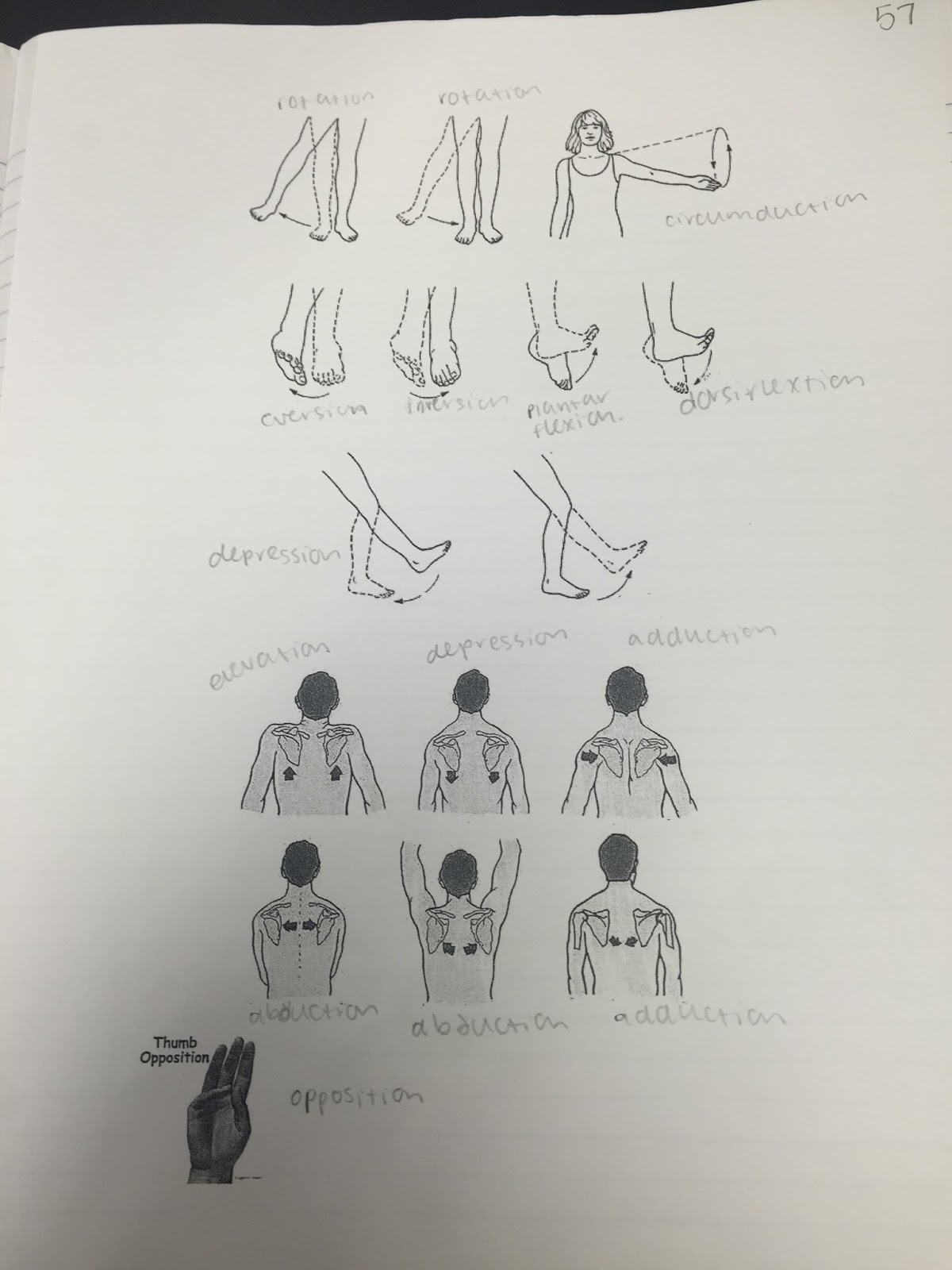
 |
| Picture from our chicken dissection |
Wednesday, March 23, 2016
Human Growth Hormone

Sunday, March 20, 2016
Chicken Disection Analysis

 In this Lab we dissected a chicken and we will be locating the main muscles. We began by removing the skin from the chest. We found the pectoralis major and the pectoralis minor which is right under it. Next we removed the skin on its back and found the trapezius and latissimus dorsi. Next we Removed the skin on the chickens wings and found the deltoid, biceps brachii and the triceps humeralis. We also found the flexor carpi ulnaris and the brachiordialis. Next we removed the skin on the chickens thigh and found the sartorius, iliotibialis, semimembranosus, semitendinous, quadriceps, and the gastrocnemius. We also found the preens longs and the tibias anterior. The pectoralis major helps pull the wing ventrally and the pectoralis minor lifts the wing dorsally. The trapezius helps shrug the shoulders and the latissimus dorsi extends or pulls the wing. The deltoid helps raise the upper wing, the biceps brachii helps bend the wing, and the triceps humeralis extends the wing. The flexor carpi unlearns flexes the hand, and the brachiordialis helps pull the hand back. The sartorius flexes the thigh, the iliotibialis extends the thigh, the biceps femurs flexes the leg and the semimembranosus extends the thigh also. Semitendinosis extends the thigh, quadriceps femurs extends the lower left, and the gastrocnemius is used for standing on your toes. The preens longs extends the foot and the tibias anterior flexes the foot. The biceps brachii is an example of an origin, and origins are the attachment site of the muscles tendon to a stationary bone. Insertion is the attachment site of a tendon to a moveable bone. There are a lot of muscles in the chicken that are pretty similar to the muscles we have. For example the deltoid what is on the center top of the shoulder of the chicken and of humans which helps to raise your upper arm or in chickens their wing. The trapezius is muscles that run perpendicular from the backbone to the shoulder of the bird and pull the shoulder back, but in humans they're split into two parts. The triceps humeralis is the muscle on the inferior side of the upper wing or arm in birds and humans, and it extends the arm or in chickens the wing.


 |
| Add caption |


Monday, February 29, 2016
Unit 6 Reflection
 |
| Owl Pellet lab |
 |
| Skeleton |
 |
| Bone slide |
Thursday, February 25, 2016
Owl Pellet Lab
 |
 |
| humerus |
 We did an Owl Pellet lab, where we dissected owl pellets and tried to figure out what type of animal the owl ate. We had to look at the bones we found and try to match them to other animal bones. Our owl pellet was 5.69 grams, 9 cm long and 2 cm wide. In it we found two skulls and a lot of very small bones. The skulls were 3.5 cm long, 2.5 cm wide and the lower jaw was 2.5 cm long and 1 cm wide. Looking at the charts and information we were given, we decided that it was a vole. The first thing we saw was the humerus, the bone has a part that pokes out and it matched the picture we had of a vole's humerus. Then the skull has a curve right after the front of the mouth and then in the back there were teeth and the vole was the only animal that has a skull with this shape. Also the lower jaw we found has the same shape as a vole. The ribs that we found in our owl pellet are very similar to ribs on a human, they are the same shape. The back bones we found were similar to human back bones because they lined up like human spines do. We found a bone which we thought was the femur and it was pretty similar to the human femur, it was the same shape and had the ball in socket joint. Some things we found different was the humerus, the bone poked out at a point and the human bone doesn't do that. Also the tibia and fibula were reversed, in the human skeleton the tibia is bigger than the fibula but in the vole, the fibula is bigger than the tibia and they were also connected. Another difference we found was in the skull, it has very big eye sockets and the mouth is a lot different. Overall we learned a lot about the differences in these bones and human bones, and also it was interesting to see what owls eat and to take apart the owl pellets.
 |
| tibia and fibula |
 |
| skull and mandible |
Wednesday, January 27, 2016
Unit 5 Reflection
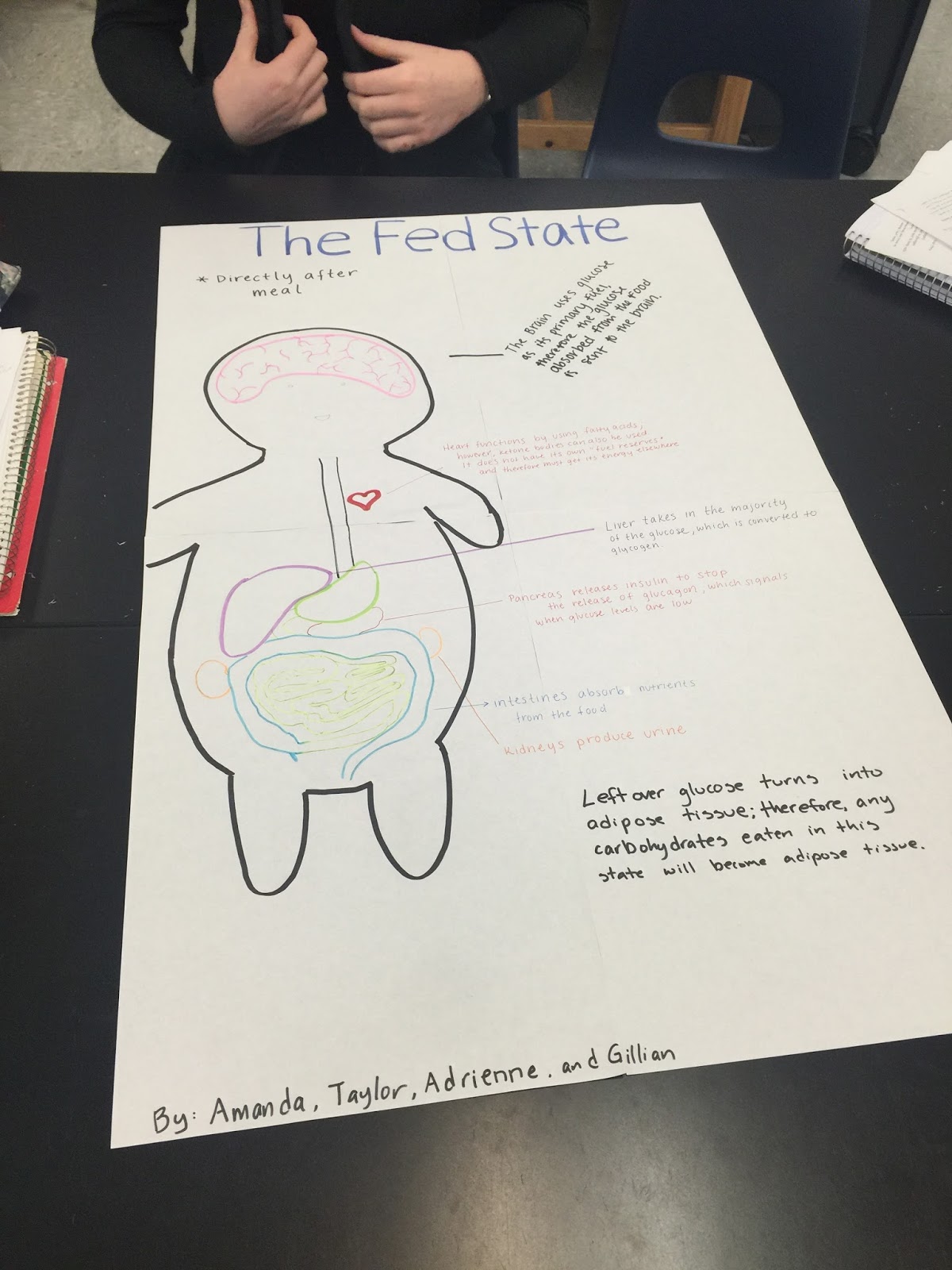 |
| Fed State Poster |
 |
| strings across the top are digestive tracts |
Wednesday, January 6, 2016
The Digestion System Lab
In this lab we measured out the length of each part of the digestive system and at the end we added up all of the lengths and got the length of our digestive tracts. The main takeaways I got from this activity is that the intestines are a lot longer than I imagined. With all of the digestive lengths put together it was very long. For our small intestine we multiplied our height times 4, which is pretty long so for it to be able to fit in our abdomen it needs to be very bunched up and folded. The small intestine is very long but it is not as wide as the large intestine. The large intestine is much wider than the small intestine but it is shorter, for this your large intestine was about your height so we used out height and measured out the yarn. My guess to how long it takes for food to move through your entire digestive system would be about 8 hours. I looked it up and it says it takes between 24-72 hours for food to move through the entire system. My guess was very off, but a big factor to how long it takes is the type of food it is. Digestion is different from absorption because digestion is breaking down food into smaller pieces and absorption is taking the needed nutrients. Your intestines are where absorption takes place and digestion involves the mouth, esophagus, stomach, small intestine, large intestine, liver, gall bladder, pancreas, anal cavity and the anus. I don't have any questions about digestion, I want to learn more about how different people can't digest foods, but others can like for example celiac disease.
Monday, January 4, 2016
New Years Goals
My first goal for the new year is I need to start putting more time aside to study. I need to be more on track with when my tests and quizzes are and plan ahead to make sure that I have enough time to go over everything and have time to study well. I also need to study more thoroughly for all of my classes. My second goal is I need to get more sleep. For me to get more sleep I need to go to bed earlier, which means I have to get my homework done earlier so I am not up late trying to finish it. I usually procrastinate when I get home from school, but I want to start getting my homework done quicker so I have more time so I can go to bed earlier. It will also help me be more awake during school.
Thursday, November 12, 2015
Sheep Heart Dissection Reflection Questions
1. What is the purpose of the pericardium?
The pericardium is a sac of serous membranes that secretes a fluid to lubricate the heart and reduce friction. It is made of visceral and parietal layers.
2. How do arteries differ from veins in their structure?
Veins carry blood from the tissues to the heart and arteries carry blood away from the heart to the tissues. Veins have thinner walls, arteries are larger and are under higher pressure.
3. What function does the auricles serve?
They are chambers that blood enters the heart.
4. What external differences of the atria and ventricles do you observe?
The walls of the ventricles are thicker, the atrium's are above the ventricles and they are smaller than the ventricles.
5. Find the following structures, and use pictures or words to describe each.
a. Coronary Sinus: receives blood from the coronary veins, and flows into the right atrium.
b. Inferior Vena Cava: Large vein that carries deoxygenated blood into the heart. Carries blood from the lower body.
c. Right Atrioventricular Valve (Tricuspid Valve): It allows blood to flow in one direction and it prevents back flow of blood. The Tricuspid Valve is between the right atrium and the right ventricle.
6. Draw a picture of the Tricuspid Valve including the chordate tendinae and the papillary muscle.

7. Why is the "anchoring" of the heart valves by the chordate tendineae and the papillary muscle important to heart function? They are there to prevent the tricuspid and bicuspid valves from collapsing into the atrium when it contracts.
8. Using pictures and/or words, describe what you see (bicuspid valve): It prevents back flow of blood, and allows blood to flow in one direction, it is between the left atrium and the left ventricle, and is also called the mitral valve.
9. What is the function of the semi-lunar valves? Semi-lunar valves prevents arterial blood from re-entering the heart.
10. a. If the valve disease occurs on the right side of the heart, it results in swelling in feet and ankles, why might this happen? Because the right side of the heart deals with deoxygenated blood, so the feet and ankles are not getting oxygenated blood.
b. If valve disease occurs on the left side of the heart, what complications would you expect to see?
The left side of the heart deals with oxygenated blood, so deoxygenated blood would be filling up the lungs, so the lungs would swell.
11. Using pictures or words, describe what you see: The coronary tendineae connects the papillary muscle to the bicuspid valve.
12. Describe the left and right sides of the heart differ from each other?
The right side of the heart deals with deoxygenated blood and the left side of the heart deals with oxygenated blood. The right side of the heart goes to the lungs and the left side comes from the lungs.
13. Draw and label all structures visible in the interior of the cross section.
The pericardium is a sac of serous membranes that secretes a fluid to lubricate the heart and reduce friction. It is made of visceral and parietal layers.
2. How do arteries differ from veins in their structure?
Veins carry blood from the tissues to the heart and arteries carry blood away from the heart to the tissues. Veins have thinner walls, arteries are larger and are under higher pressure.
3. What function does the auricles serve?
They are chambers that blood enters the heart.
4. What external differences of the atria and ventricles do you observe?
The walls of the ventricles are thicker, the atrium's are above the ventricles and they are smaller than the ventricles.
5. Find the following structures, and use pictures or words to describe each.
a. Coronary Sinus: receives blood from the coronary veins, and flows into the right atrium.
b. Inferior Vena Cava: Large vein that carries deoxygenated blood into the heart. Carries blood from the lower body.
c. Right Atrioventricular Valve (Tricuspid Valve): It allows blood to flow in one direction and it prevents back flow of blood. The Tricuspid Valve is between the right atrium and the right ventricle.
6. Draw a picture of the Tricuspid Valve including the chordate tendinae and the papillary muscle.

7. Why is the "anchoring" of the heart valves by the chordate tendineae and the papillary muscle important to heart function? They are there to prevent the tricuspid and bicuspid valves from collapsing into the atrium when it contracts.
8. Using pictures and/or words, describe what you see (bicuspid valve): It prevents back flow of blood, and allows blood to flow in one direction, it is between the left atrium and the left ventricle, and is also called the mitral valve.
9. What is the function of the semi-lunar valves? Semi-lunar valves prevents arterial blood from re-entering the heart.
10. a. If the valve disease occurs on the right side of the heart, it results in swelling in feet and ankles, why might this happen? Because the right side of the heart deals with deoxygenated blood, so the feet and ankles are not getting oxygenated blood.
b. If valve disease occurs on the left side of the heart, what complications would you expect to see?
The left side of the heart deals with oxygenated blood, so deoxygenated blood would be filling up the lungs, so the lungs would swell.
11. Using pictures or words, describe what you see: The coronary tendineae connects the papillary muscle to the bicuspid valve.
12. Describe the left and right sides of the heart differ from each other?
The right side of the heart deals with deoxygenated blood and the left side of the heart deals with oxygenated blood. The right side of the heart goes to the lungs and the left side comes from the lungs.
13. Draw and label all structures visible in the interior of the cross section.


Wednesday, November 11, 2015
Unit 3 Reflection
This unit taught us all about the circulatory system, the major components, specific parts, accessory organs, and much more. The cardiovascular system is a fluid filled network of tubes or vessels, through which materials move between the environment and the cells of a multicellular animal. Cardiovascular health is making sure that you keep your heart healthy. Theres several things that cause heart attacks, a heart attack is when blood supply to the myocardium is severely reduced, or stopped resulting in damage to the heart cells or death of heart cells. This is caused by one or more coronary arteries blocked, usually due to atherosclerosis. Stroke is a brain injury that occurs when blood supply to part of the brain is interrupted. This is also often caused by atherosclerosis, but can be caused by an aneurysm. To promote your cardiovascular health, you can control your blood pressure, stop smoking, control cholesterol, eat a healthy diet, drink alcohol in moderation, control diabetes, control your weight, exercise, manage your stress, and your genetic history. I think this unit was very interesting because it applies to our lives, and it helped me understand what happens when these things go wrong. Also it taught me ways of identifying these situations, which is important to know. This unit we did our first dissection, and it was helpful to actually see the parts of the heart it made it easier to understand how it works. For the remainder of the semester, I want to study more and the temp checks are very helpful, so its nice when we have them because it lets me know how much information I retained, so my goal is to study more and do better on tests.
 |
| Sheep heart dissection |
 |
| Heart Diagram |
 |
| Atherosclerosis |
Monday, October 26, 2015
Monday Wellness: Snacking
The snack we made during class was healthy because we used apples which are a good source of vitamin c,and organic peanut butter which has no trans fats, and it almonds which the peanut butter and almonds has a lot of iron and magnesium. I usually eat snacks every couple of hours, depending on when i'm hungry. A healthy snack is something that isn't artificially flavored. Snacks to stay away from would probably things with a lot of empty calories and with little nutritional values.


Tuesday, October 13, 2015
Blood Pressure Lab
Systolic Blood pressure is the first number you record when taking someones blood pressure. For example if your blood pressure is 120/80 the systolic blood pressure is 120. It represents the pressure when the heart contracts. Your diastolic blood pressure is the second number and it is when the heart relaxes. We used a stethoscope to measure our heart rates, and to measure our blood pressure we used stethoscope and a sphygomomanometer. Using your thumb to measure blood pressure is not ideal because your thumb has a heart beat also, so it would interfere with the other heart beat your measuring. To use a sphygomomanometer you put it on the person's upper arm whose blood pressure is being measured and you tighten it so its tight but not restricting. To record the blood pressure you need a stethoscope so you would place it on their inner elbow and the hearing parts in your ears to listen, then you would have one hand on the stethoscope and your other hand holding the bulb that you squeeze your hand and it pumps air into the arm cuff. You pump the bulb until its around 180 and then you slowly release the air, you listen for the heart beat and as soon as you hear it you record the first number and then when the heart beat noise stops you record that number too. You put the first number you recorded over the second number you recorded and thats your blood pressure.
 |
| Charts |
 |
| Blood Pressure Cuff and Stethoscope |
Sunday, October 11, 2015
Unit 2 Reflection
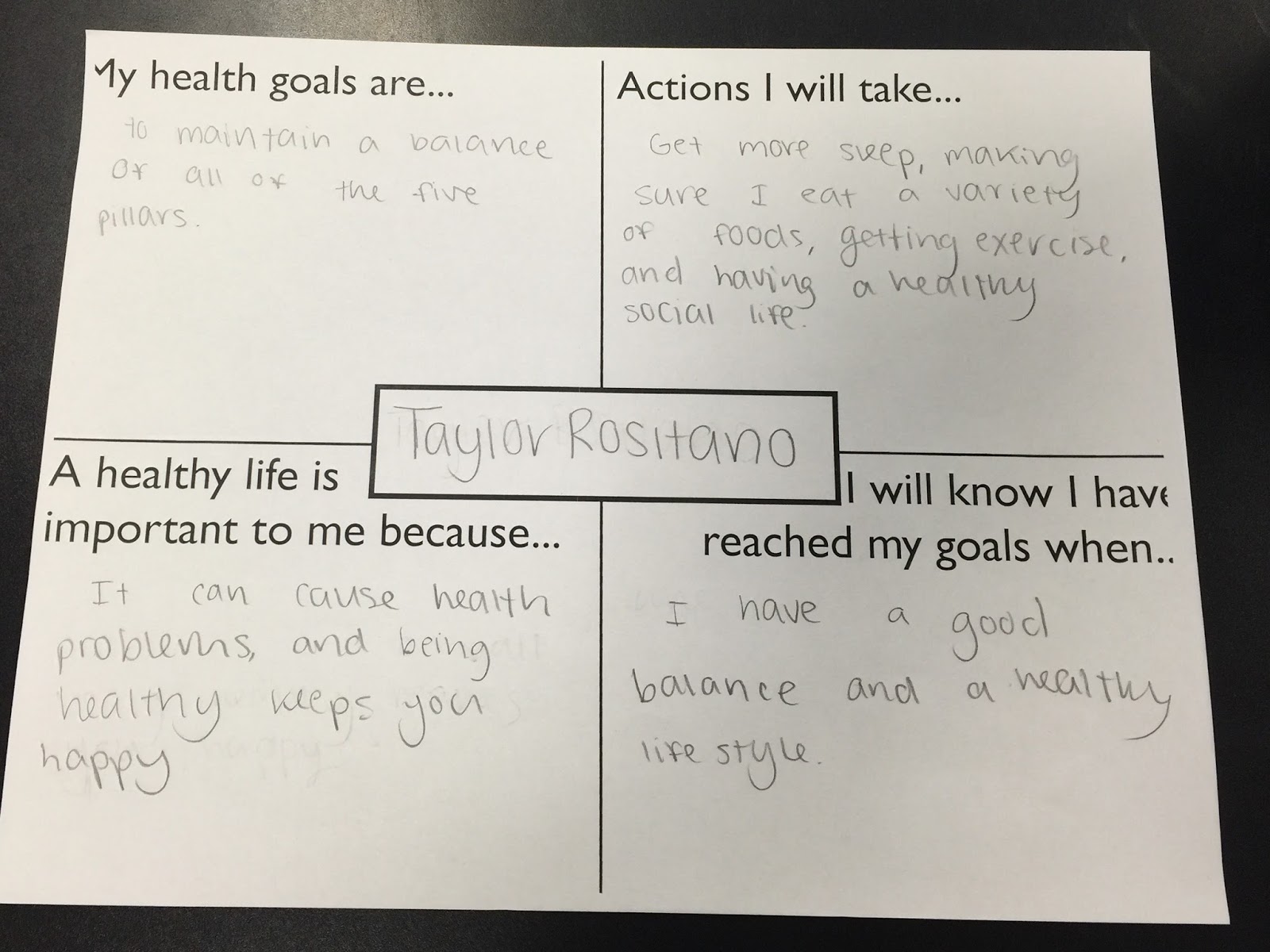
Health is the measure of our bodies efficiency and over all well being. Being healthy means you have a good balance of all of the five pillars of health, nutrition, exercise, sleep, stress, and social. We learned that nutrition is really important because the nutrients support growth and energy needs, also its important to exercise often because it keeps you healthy and helps strengthen your body. Sleep is extremely important because it gives your body time to rest and restore, stress deals with managing constant changes to your body and mind, so its important to manage stress well. Your social life is the way we interact with our environment, so when you have a poor social life it can cause stress, keeping a good social life will help keep you healthy. For my personal health, I would say I'm an averagely healthy person. For nutrition, there were certain things I should change, like eating more seafood, and less salty foods. My social life is good, I have a really good group of friends that keep me happy. I play sports everyday for the correct amount of time, and for sleep I get a but under what I should be. I get very little sleep during the week, and then on weekends I sleep for a very long time, so I need to find a balance so that I can get into having a normal sleep schedule. That would help me be more motivated and it would help me focus during school.
This unit taught me a lot of things that can be applied to my life, which was very helpful. I learned more about the foods we should be eating and why we need them. For example, we need proteins for energy (if needed), repair and maintenance, hormones, and the transportation and storage of molecules. Also I learned why its so important to stay hydrated, because all of our cell and organ functions depend on it, and it helps regulate our body temperature. For exercise, Mr.Orre told us what types of exercise there are, what intensities you should be doing, the three metabolic pathways, and how much exercise we should be getting in order to stay healthy. You should be getting 150-300 minutes of moderate to high intensity exercise. We learned about sleep and the hormones that effect our sleep, like cortisol and melatonin. Cortisol is a hormone that is secreted by the adrenal glands and it tells your brain that its daytime and it wakes you up. Melatonin is a hormone secreted by the pineal gland, it causes you to feel sleepy. Most teenagers need around 9-10 hours of sleep a night and when you don't get enough sleep, your sleep debt keeps adding up. Mr.Orre also told us about stress, when its good and when its bad.
Something I didn't fully understand was the hormones lesson, about insulin, leptin, leptin resistance, glucagon and cortisol. To improve for the next unit I will make sure I get enough sleep so that in class I am awake and alert, also I will make sure I take good notes, and study better for the unit test. I can connect this unit to my life because I play sports everyday, so it helped me understand why it is important, also all of the topics we learned about helped me learn how to improve my health. For example I play waterloo, which is good exercise, plus it also effects my social life, we have a very close team, and we have a stronger team because we get along so well together.
This unit taught me a lot of things that can be applied to my life, which was very helpful. I learned more about the foods we should be eating and why we need them. For example, we need proteins for energy (if needed), repair and maintenance, hormones, and the transportation and storage of molecules. Also I learned why its so important to stay hydrated, because all of our cell and organ functions depend on it, and it helps regulate our body temperature. For exercise, Mr.Orre told us what types of exercise there are, what intensities you should be doing, the three metabolic pathways, and how much exercise we should be getting in order to stay healthy. You should be getting 150-300 minutes of moderate to high intensity exercise. We learned about sleep and the hormones that effect our sleep, like cortisol and melatonin. Cortisol is a hormone that is secreted by the adrenal glands and it tells your brain that its daytime and it wakes you up. Melatonin is a hormone secreted by the pineal gland, it causes you to feel sleepy. Most teenagers need around 9-10 hours of sleep a night and when you don't get enough sleep, your sleep debt keeps adding up. Mr.Orre also told us about stress, when its good and when its bad.
Something I didn't fully understand was the hormones lesson, about insulin, leptin, leptin resistance, glucagon and cortisol. To improve for the next unit I will make sure I get enough sleep so that in class I am awake and alert, also I will make sure I take good notes, and study better for the unit test. I can connect this unit to my life because I play sports everyday, so it helped me understand why it is important, also all of the topics we learned about helped me learn how to improve my health. For example I play waterloo, which is good exercise, plus it also effects my social life, we have a very close team, and we have a stronger team because we get along so well together.
 |
| Nutrition |
 |
| Goals Sheet |
 |
| Exercise/Social |
Subscribe to:
Posts (Atom)